
AI Property Valuation Guide: Trust Smarter Estimates
AI property valuation guide to understand automated estimates, software limits, comps, reliability, and when to trust valuation outputs. Learn practical
What Is AI Property Valuation?
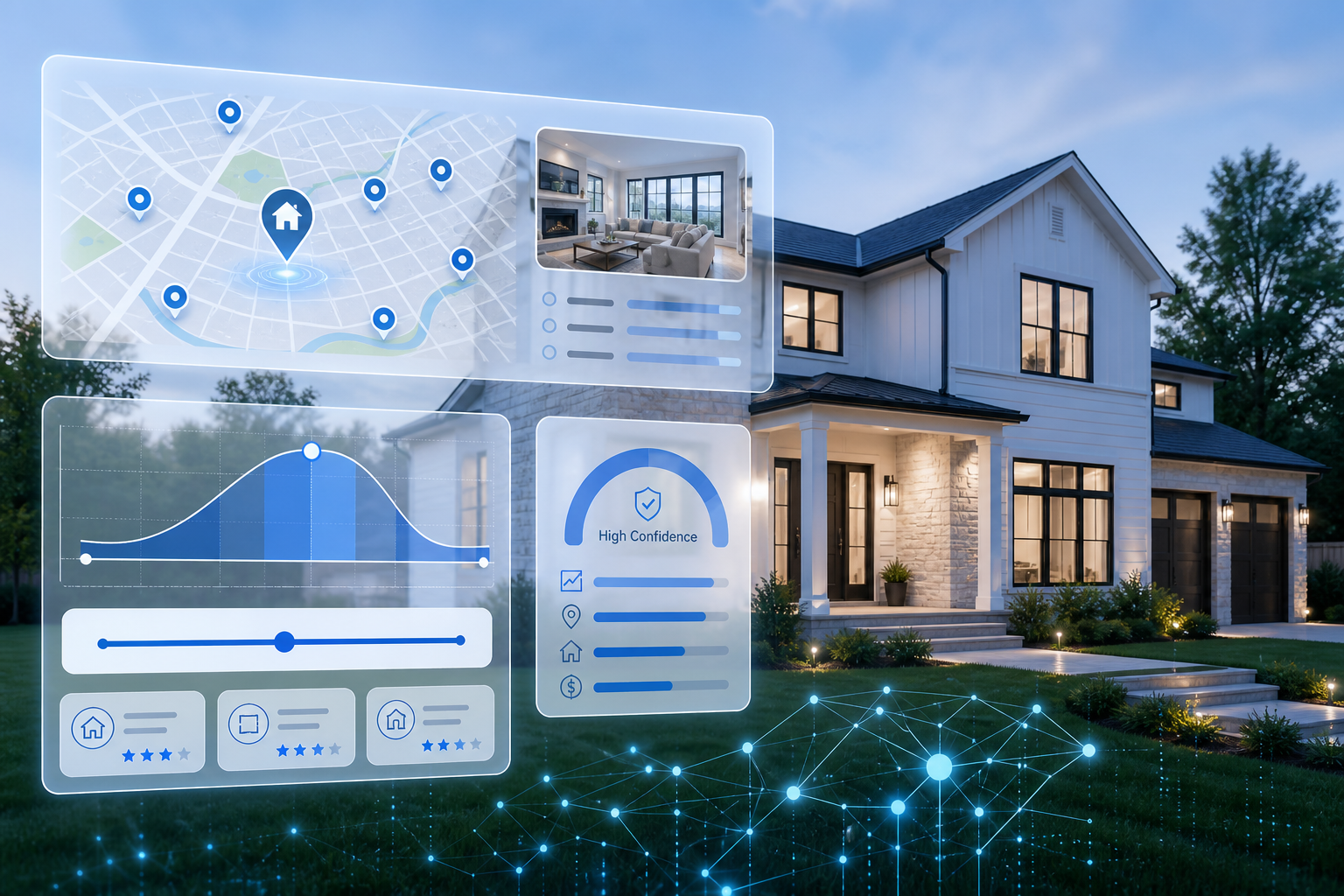
AI property valuation uses property facts, comparable sales, market activity, location, timing, and sometimes photos or condition signals to estimate what a residential property may be worth today. It is useful decision support, but the result should be interpreted against local comparable sales, inventory, property condition, and the purpose of the valuation.
In residential real estate, property valuation is an evidence-based estimate of what a home may be worth in a specific market at a specific point in time. It is not a universal truth about the property. A home can have one reasonable value for a quick investor offer, another for a retail listing strategy, and another for a lender-ordered appraisal.
AI property valuation sits inside a broader valuation toolkit:
| Term | What it usually means |
|---|---|
| Automated property valuation | A data-driven estimate produced from property records, sales, and market data |
| Property valuation software | A platform that helps users estimate, compare, document, and report property value |
| Home value estimate | A general estimate of a home’s likely market value, often consumer-facing |
| AI home appraisal | Often used informally to mean an AI-generated value estimate; it is not automatically a licensed appraisal |
| CMA | A comparative market analysis prepared by a real estate agent using comparable sales and local judgment |
| Licensed appraisal | A formal valuation performed by a credentialed appraiser, often for lending, legal, tax, or regulated purposes |
| Pricing recommendation | A strategic list-price or offer-price suggestion based on value, competition, timeline, and goals |
Traditional automated valuation models, often called AVMs, estimate value using structured property, transaction, and market data. AI-assisted valuation may go further by adding pattern recognition, image interpretation, anomaly detection, confidence scoring, and clearer explanations for why certain comparable properties matter.
The key point: AI can make property value estimation faster and more transparent, but it should not turn a complex market decision into blind trust in a single number.
How Automated Property Valuation Works: Inputs, Methods, and Outputs
Automated property valuation works by combining property characteristics, comparable evidence, condition signals, and market context into a likely value estimate or range. The strongest estimates usually come from recent, nearby, highly similar transactions. The weakest estimates happen when comparable data is sparse, stale, inconsistent, or hard to interpret.
Most property valuation software starts with core property data, including:
- Full address and location
- Property type, such as single-family, condo, townhouse, or multifamily
- Bedrooms and bathrooms
- Square footage
- Lot size
- Year built
- Parking, garage, and driveway details
- Basement, attic, ADU, or finished lower-level information
- Recent improvements or renovations
- Listing history
- Prior sale history
- Active, pending, withdrawn, and expired listings
- Local inventory and days on market
- Market liquidity, meaning how often similar homes actually sell
The software then compares the subject property to market evidence. A standard suburban home in a subdivision with five recent similar sales is easier to estimate than a custom rural home on acreage with no recent nearby sales.
Common valuation methods in residential real estate
Most automated property valuation systems draw from one or more familiar valuation approaches.
| Method | How it applies to residential property |
|---|---|
| Sales comparison approach | Compares the property to recently sold similar homes; this is the most common method for typical owner-occupied homes |
| Income approach | Estimates value based on income potential; useful for rentals and investor-owned properties |
| Cost approach | Considers land value plus replacement or construction cost minus depreciation; useful for new builds or unusual properties |
| AVM | Uses structured data and statistical modeling to estimate value quickly |
| AI-assisted hybrid method | Combines AVM-style data modeling with AI pattern recognition, photo analysis, explanation layers, and confidence scoring |
For most homes, the sales comparison approach matters most. Buyers and sellers anchor to what similar homes recently sold for, how long they took to sell, and how they compare in size, condition, features, and location.
For rental properties, income matters more. An investor may care less about emotional appeal and more about rent, vacancy, operating expenses, cap rate, cash flow, and exit value.
For unique or newly built properties, the cost approach may be more useful because comparable sales may not capture the cost of land, materials, design, and construction.
How condition and photos influence AI estimates
Condition is one of the hardest parts of automated property valuation. Public records may say two homes are both 2,000 square feet with four bedrooms, but one may have a new kitchen, updated bathrooms, fresh paint, and strong curb appeal while the other needs roof, HVAC, and flooring work.
More advanced real estate AI tools may analyze photos or listing media to identify signals such as:
- Renovation quality
- Kitchen and bathroom updates
- Visible deferred maintenance
- Flooring condition
- Natural light
- Curb appeal
- Landscaping
- Staging and presentation
- Signs of distress or neglect
- Outdated finishes
These signals do not replace an in-person inspection. They can, however, help explain why two similar homes may deserve different value ranges.
Why the output should be a range, not a magic number
A responsible property value estimation process should produce a range or confidence interval, not just a single unquestioned figure.
For example, a tool might estimate:
- Likely value: $625,000
- Reasonable range: $600,000–$650,000
- Confidence: High
- Main support: Four recent comparable sales within one mile
- Risk factor: Subject property condition not fully verified
That range is more useful than a single number because real estate is negotiated in a live market. Buyer demand, mortgage rates, inventory, inspection findings, appraisal requirements, and listing strategy can all affect final price.
AI Valuation vs AVM vs CMA vs Appraisal: Which One Should You Use?
Use the valuation method that matches the decision. An AVM can be helpful for a fast baseline. An AI-assisted valuation can add richer comparable analysis and explanation. A CMA adds agent judgment and local nuance. A licensed appraisal is required when the valuation must meet lender, legal, tax, estate, divorce, or other regulated standards.
| Method | Best use case | Strengths | Limitations | When to use it |
|---|---|---|---|---|
| AVM | Quick baseline estimate | Fast, scalable, data-driven | May miss condition, local nuance, and unusual property factors | Early research, portfolio screening, rough value checks |
| AI-assisted valuation | More transparent property value estimation | Can analyze data patterns, photos, comparables, confidence, and anomalies | Still depends on data quality and does not replace required appraisal work | Listing prep, offer strategy, investor analysis, valuation review |
| CMA | Pricing and market strategy | Adds agent experience, buyer behavior, and neighborhood nuance | Can vary by agent skill and assumptions | Setting list price, evaluating offers, positioning against competition |
| Licensed appraisal | Formal valuation for regulated needs | Credentialed, documented, accepted for many lending and legal purposes | Slower, more expensive, still based on professional judgment | Mortgage lending, estate, divorce, tax, court, legal, or regulated decisions |
| Pricing recommendation | Action-oriented list or offer price | Connects value to timeline, competition, and negotiation strategy | Not the same as pure market value | Deciding where to list, offer, counter, or reduce price |
An AI home appraisal estimate is not automatically a licensed appraisal. The phrase may sound official, but unless a licensed or certified appraiser completed the work under the applicable professional and regulatory standards, it should be treated as a decision-support estimate.
This boundary matters. AI valuation outputs should not replace appraisals required by lenders, courts, tax authorities, or regulated assignments. They are best used to improve preparation, test assumptions, and make better-informed decisions before a formal valuation is needed.
A practical way to choose:
- Need a quick starting point? Use an AVM or AI valuation.
- Need to understand the “why” behind the number? Use AI-assisted comparable analysis.
- Need a pricing strategy for the open market? Use a CMA plus AI valuation support.
- Need a value for lending, court, tax, estate, or divorce? Get a licensed appraisal.
- Need to decide whether a deal works? Use valuation software, then stress-test the assumptions manually.
What You Need Before Running an AI Property Valuation
Better inputs create better outputs. Before entering a property into valuation software, gather accurate property characteristics, condition details, and decision context. Small mistakes in square footage, finished space, renovation status, or property type can materially change the estimate.
Use this pre-valuation checklist before running an AI property value estimate.
Property facts checklist
- Full property address
- Property type: single-family, condo, townhouse, duplex, triplex, multifamily, or other
- Bedrooms
- Bathrooms
- Above-grade square footage
- Finished basement or lower-level square footage
- Lot size
- Year built
- Parking type and number of spaces
- Garage, carport, or driveway details
- ADU, guest house, in-law suite, or accessory structure
- Basement status: none, unfinished, partially finished, fully finished, walkout
- HOA status and monthly or annual dues
- Occupancy status: owner-occupied, tenant-occupied, vacant, distressed, or under renovation
Condition and improvement checklist
- Kitchen update status
- Bathroom update status
- Roof age and condition
- HVAC age and condition
- Window age and condition
- Flooring condition
- Exterior condition
- Landscaping and curb appeal
- Recent renovations
- Known permits, if available
- Deferred maintenance
- Structural concerns
- Water, mold, foundation, or drainage issues
- Staging quality
- Current photos or listing photos
- Unusual features, such as views, pool, solar, acreage, workshop, elevator, or waterfront access
Valuation context checklist
Before running the estimate, define why you need it. A valuation for listing preparation is different from a valuation for refinance planning or investment underwriting.
Clarify:
- Intended use case
- Desired timeline
- Target list price or offer decision
- Financing constraints
- Investor return requirements, if applicable
- Local rules that may affect use, rentals, permits, or financing
- Whether the property is owner-occupied, rental, distressed, vacant, or under construction
- Whether the estimate will support a conversation with an agent, lender, appraiser, attorney, investor, or family member
For example, a homeowner preparing to sell may want to know the likely retail list range and which improvements could increase appeal. An investor may care more about after-repair value, rent potential, renovation budget, and resale risk. A brokerage may want consistent valuation documentation across a team.
The more clearly you define the decision, the more useful the AI valuation becomes.
Step-by-Step AI Property Valuation Guide: How to Use an Estimate Responsibly
A good AI property valuation guide is not just about running a tool. It is about building a repeatable workflow that defines the purpose, checks the data, reviews the evidence, stress-tests the result, and updates the estimate when market conditions change.
Step 1: Define the valuation purpose
Start with the decision you need to make. Common purposes include:
- Listing preparation
- Offer strategy
- Refinance planning
- Portfolio screening
- Estate planning preparation
- Investment underwriting
- Renovation feasibility
- Tax or assessment review preparation
- Buy-and-hold rental analysis
- Pre-appraisal expectation setting
Write the purpose in one sentence.
For example:
- “I need a likely list-price range for selling within 45 days.”
- “I need to know whether this rental acquisition still works if resale value is 5% lower than expected.”
- “I need a value range before speaking with a lender about refinancing.”
This prevents you from overusing a number that was created for the wrong decision.
Step 2: Run the estimate with complete inputs
Enter the cleanest property data available. Confirm the address, square footage, bedrooms, bathrooms, lot size, property type, and condition details.
Then review:
- Assumed property characteristics
- Comparable sales selected
- Active and pending competition
- Withdrawn or expired listings
- Confidence range
- Data recency
- Adjustment logic, if shown
- Whether photos or condition signals were used
- Whether the tool explains why it produced the result
If the estimate is high or low, do not dismiss it immediately. Ask why. Sometimes the model caught a market shift. Sometimes it relied on a poor comparable. Sometimes the public record is wrong.
Step 3: Stress-test the estimate
Stress-testing is where the valuation becomes useful.
Ask:
- Are the comparables truly similar?
- Are they in the same school zone, subdivision, building, or micro-market?
- Did any comparable have a superior lot, view, renovation, or location?
- Are active listings priced above or below recent sold prices?
- Are pending listings moving quickly or sitting?
- Are withdrawn listings showing where sellers overreached?
- Is the subject property better or worse than the model assumes?
- Would a buyer actually choose this property over the comparable homes?
- Has the market shifted since the most relevant sales closed?
Then test a few scenarios:
| Scenario | Question to ask |
|---|---|
| Conservative | What if buyers discount condition or rates soften demand? |
| Base case | What value is most supported by recent similar sales? |
| Optimistic | What if presentation, low inventory, or strong demand supports a premium? |
| Fast-sale | What price creates urgency? |
| Appraisal-risk | What value can be defended with closed comparable sales? |
This is especially important in volatile markets. Valuation ranges should be updated when market conditions or comparable sales change materially. A strong estimate from 60 days ago may be stale if mortgage rates changed, inventory doubled, or a new comparable closed nearby.
Step 4: Document your conclusion
Do not stop at the software output. Write down your valuation conclusion and reasoning.
Include:
- Date of estimate
- Tool or method used
- Estimated range
- Most likely value or recommended action price
- Top comparable sales
- Active competition
- Condition assumptions
- Known risks
- Next step
Example:
“Based on three recent sales between $610,000 and $640,000, one active competitor at $649,000, and subject condition that appears slightly above average, the supported range is $615,000–$645,000. For a 30-day listing strategy, a recommended list price may be $635,000, subject to agent review and final condition verification.”
That short note is far more useful than a screenshot of a number.
How Accurate Is Property Valuation Software, and How Do You Choose Real Estate AI Tools?
Property valuation software accuracy depends on data quality, comparable availability, property uniqueness, condition visibility, and market volatility. It works best when the property is typical for its area and recent similar sales are available. It struggles most when records are wrong, the property is unusual, or the local market is changing quickly.
Automated property valuation tends to work well for:
- Standard homes in active markets
- Subdivisions with consistent floor plans
- Condos with many same-building or same-complex sales
- Properties with clean public records
- Areas with recent nearby comparable sales
- Homes where condition is visible through photos or listing data
- Markets with stable buyer demand and predictable inventory
It tends to struggle with:
- Rural homes
- Luxury properties
- Unique architecture
- Waterfront, acreage, or view-heavy properties
- Major unpermitted improvements
- Distressed sales
- Homes with incomplete or inaccurate public records
- Rapidly shifting markets
- Thin transaction data
- Stale comparable sales
- Properties with hidden condition issues
- Mixed-use or hard-to-classify properties
The question is not “Is AI always accurate?” The better question is “Is this estimate reliable enough for this decision?”
A low-stakes early screening decision may not need perfect precision. A lender, court, tax, estate, divorce, or high-dollar acquisition decision needs a higher standard and may require a licensed appraisal or professional valuation support.
Real estate AI tool selection checklist
When comparing real estate AI tools, look beyond the headline estimate. The best property valuation software should help you understand the evidence behind the value.
Use this checklist:
- Transparency: Does the tool show the comparable sales and assumptions?
- Data coverage: Does it include sold, active, pending, withdrawn, and listing-history data where available?
- Explainability: Does it explain why the estimate changed or why certain comps matter?
- Condition awareness: Can it account for renovations, deferred maintenance, or photo-based signals?
- Confidence scoring: Does it show when the estimate is strong or weak?
- Auditability: Can you save, export, or revisit the valuation record?
- Update frequency: How often does the data refresh?
- Collaboration: Can agents, analysts, or team members review the same valuation?
- Reporting: Can you produce a client-ready or internal report?
- Exports: Can you export data for underwriting, CRM, or portfolio review?
- Privacy: How is property and user data handled?
- Permissions: Can teams control access by role?
- Integrations: Does it fit existing brokerage, investor, or operations workflows?
- Pricing model: Does the pricing fit your volume and use case?
For homeowners, the most important features are clarity, comparable support, and condition awareness. For agents, reporting and explanation matter. For investors, exportability, assumptions, and scenario testing matter. For brokerages, consistency, team controls, and auditability matter.
The best tools do not simply say “this home is worth $X.” They help answer: “What evidence supports this value, what could make it wrong, and what should I do next?”
FAQ
What is AI property valuation?
AI property valuation is the use of property data, comparable sales, market trends, location, timing, and sometimes photos or condition signals to estimate a home’s value. It is best treated as decision support, not as a guaranteed sale price or automatic substitute for a licensed appraisal.
How does automated property valuation work?
Automated property valuation uses property records, sales history, listing activity, comparable homes, market conditions, and statistical or AI models to estimate value. Strong estimates usually rely on recent, nearby, similar sales. Weaker estimates often occur when data is sparse, outdated, incorrect, or the property is unusual.
Is an AI home appraisal the same as a licensed appraisal?
No. An AI home appraisal estimate is not automatically a licensed appraisal. A licensed appraisal is a formal valuation completed by a credentialed appraiser under applicable standards. AI estimates can support research and preparation, but they should not replace appraisals required for lending, legal, tax, estate, divorce, or regulated purposes.
What information do I need for accurate property value estimation?
You need accurate property facts, including address, property type, bedrooms, bathrooms, square footage, lot size, year built, parking, basement status, HOA details, and occupancy. You should also provide condition details, renovations, maintenance issues, photos, unusual features, and the reason you need the valuation.
How accurate is property valuation software?
Property valuation software is most accurate when there are recent, nearby, similar sales and clean property data. Accuracy can decline for rural homes, luxury homes, unique properties, distressed sales, rapidly changing markets, incorrect records, or homes with hidden condition issues. Always review the comparable evidence and confidence range.
When should I trust an AI property value estimate, and when should I get a human appraisal?
Trust an AI estimate for early research, listing preparation, offer strategy, portfolio screening, and assumption testing when the data is strong and the comparables make sense. Get a licensed appraisal when the value will be used for lending, court, tax, estate, divorce, legal, or other regulated purposes—or when the property is complex enough that human inspection and professional judgment are essential.